

Lithium vs Lead-Acid Golf Cart Batteries: Total Cost of Ownership Explained
The battery question comes up in almost every fleet purchase: lithium or lead-acid? The honest answer is that it depends on how you use the vehicle — but for most commercial and daily-use buyers, the math increasingly points to lithium.
This guide compares the two on the factors that actually affect your budget: upfront price, lifespan, charging, maintenance, and total cost of ownership (TCO).

Upfront Cost: Lead-Acid Wins, Barely
Lead-acid batteries have a lower sticker price, which is why they still appear on entry-level carts. A lead-acid set can cost a fraction of a comparable lithium pack at purchase.
But the purchase price is only the beginning of the story. A battery that needs replacing three times during the life of the cart is not "cheaper" — it is just cheaper today.
Lifespan: Where Lithium Pulls Ahead
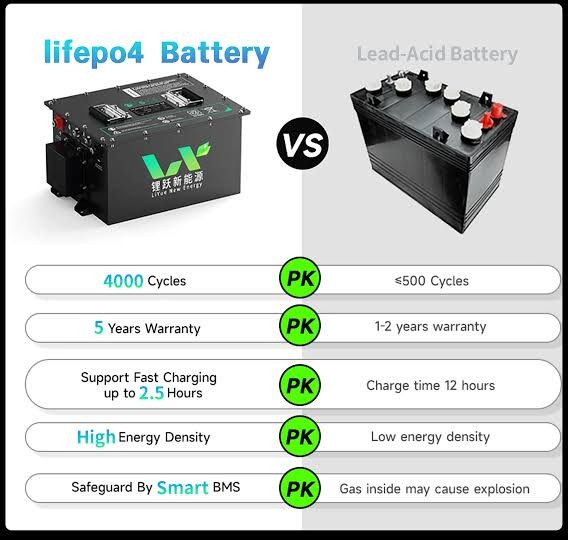
Cycle life is the number of full charge/discharge cycles a battery delivers before it degrades:
Lead-acid: typically 500–1,000 cycles under daily fleet use.
Lithium (LiFePO4): commonly 2,000–5,000 cycles.
In practical terms, a lithium pack often outlasts two or three lead-acid replacements. For a cart in daily service, that difference shows up within the first two to three years.
Charging and Usable Energy
Lithium charges faster and accepts partial charges without damage, so vehicles spend less time idle. Lithium also delivers more usable energy from its rated capacity — you can regularly use 80–90% of the pack, versus roughly 50% for lead-acid without shortening its life.
Maintenance: The Hidden Cost Saver
Lead-acid batteries require regular watering, terminal cleaning, and equalizing charges, plus handling of corrosive acid. Lithium needs essentially none of this.
For fleet managers, the maintenance gap is not just about money — it is about downtime. Every hour a cart is being serviced is an hour it is not earning.
Total Cost of Ownership: The Real Comparison
When you add batteries, replacements, labor, charging efficiency, and downtime over a 5–7 year horizon, lithium frequently costs less per usable year — especially above low annual usage.
| Factor | Lead-Acid | Lithium (LiFePO4) |
|---|---|---|
| Upfront price | Lower | Higher |
| Cycle life | 500–1,000 | 2,000–5,000 |
| Charge time | Slower | Faster |
| Maintenance | High (watering/acid) | Very low |
| 5-yr TCO (daily use) | Higher | Lower |
When Lead-Acid Still Makes Sense
Lead-acid is reasonable for very low-usage carts — a weekend personal cart used a few times a month, where the longer lifespan of lithium is never fully used. For everything else — resorts, communities, airports, commercial fleets — lithium is the stronger business case.
HDK Electric Vehicle offers lithium (LiFePO4) configurations across the D-series, D-MAX, and utility ranges, with battery options matched to your duty cycle. Talk to our team about the right pack for your fleet.
FAQ
Are lithium golf cart batteries worth the extra cost?
For daily-use fleets, usually yes. Lithium costs more upfront but lasts several times longer, charges faster, and needs almost no maintenance — lowering the total cost of ownership over the vehicle's life.
How long do lithium golf cart batteries last vs lead-acid?
Quality LiFePO4 packs commonly deliver 2,000–5,000 charge cycles, while lead-acid typically delivers 500–1,000 cycles under daily use. That means lithium often outlasts multiple lead-acid replacements.
Do lithium golf cart batteries need maintenance?
Very little. There is no watering, no equalizing charge, and no acid to handle. A basic annual inspection is usually enough, which is why fleets value them for reduced downtime.
Get Your Free Factory Quote
Tell us your model and market — our sales team replies within 1 business day with MOQ, pricing and lead time.