


Lithium vs Lead-Acid Golf Cart Batteries: Which Should You Choose
Battery choice is the single most consequential decision you make when buying an electric golf cart. It determines how far the vehicle goes, how long it lasts, how much downtime you absorb, and — over a five-year horizon — how much the fleet actually costs you. Most buyers frame it as "lithium is expensive, lead-acid is cheap." That framing is wrong, and it is the reason a lot of fleets overspend.
1. The short answer
Choose lithium (LiFePO4) if the vehicle runs daily, if you charge overnight and need it ready every morning, if you cannot afford a maintenance routine, or if you are buying for a fleet that will still be in service in five years. Choose lead-acid only if the cart is used lightly and seasonally, if upfront budget is the hard constraint, and if you have someone who will actually check water levels every month.
For most commercial operations — resorts, campuses, factories, gated communities — lithium now wins on lifetime cost, not just on convenience.
2. Lifespan and cycle life
Cycle life is where the two chemistries separate most sharply.
Flooded lead-acid: roughly 500–800 full cycles under real-world fleet use. In daily service that is typically 2–3 years before capacity falls below usable levels.
AGM / gel lead-acid: somewhat better, around 600–1,000 cycles, at a higher purchase price.
LiFePO4 lithium: 3,000–5,000 cycles to 80% depth of discharge. In daily service that is commonly 8–10 years.
A fleet that replaces lead-acid packs twice will usually have spent more than it would have on one lithium pack — before counting the labour and downtime of those replacements.
Depth of discharge matters
Lead-acid batteries degrade quickly if discharged deeply; the practical rule is to keep them above 50% state of charge. Lithium packs tolerate 80–90% depth of discharge routinely. Net effect: a nominal 100Ah lead-acid pack and a 100Ah lithium pack do not deliver the same usable energy — the lithium pack delivers roughly 60–80% more usable capacity.
3. Weight, range and performance
A lead-acid golf cart pack weighs 250–350 kg. An equivalent lithium pack weighs 60–90 kg. Removing 200 kg from a small vehicle changes its behaviour in ways buyers notice immediately:
Longer range per charge — less mass to move.
Better hill climbing — noticeable on resort and campus gradients.
Less turf and floor damage — lighter vehicles are gentler on grass, paving and factory floors.
Less brake and suspension wear — lower mass means lower mechanical load.
4. Charging time and opportunity charging
Lead-acid packs need 6–8 hours for a full charge, plus a cooling period, and they should not be interrupted mid-cycle without penalty. Lithium packs charge in 2–4 hours and tolerate partial charging with no memory effect.
That difference is operationally decisive. A resort that runs two shifts can top lithium carts up between shifts. A warehouse can charge during a break. With lead-acid, you need enough vehicles to cover the full charging window — which means buying more vehicles to do the same work.
5. Maintenance and downtime
Flooded lead-acid requires monthly watering, terminal cleaning, and ventilation to manage hydrogen gas during charging. Miss the watering schedule and you accelerate plate sulfation permanently.
LiFePO4 packs are sealed and maintenance-free. There is no water to add, no corrosion to clean, and no gassing to ventilate. An integrated BMS (battery management system) monitors cell balance, temperature, over-current and over-discharge, and shuts the pack down before damage occurs.
6. Total cost of ownership
Sticker price favours lead-acid. Lifetime cost usually favours lithium. A simplified comparison for a single vehicle over eight years:
Lead-acid: lower initial cost, but 2–3 replacement packs, monthly labour, higher energy consumption (lower charge efficiency), and more vehicles needed to cover charging windows.
Lithium: higher initial cost, no scheduled replacement within the period, minimal labour, higher charge efficiency, and better vehicle utilisation.
The crossover point depends on duty cycle. Above roughly 150–200 charge cycles per year, lithium is almost always cheaper over the life of the vehicle.
7. Safety and warranty considerations
Both chemistries are safe when built and used correctly, but they fail differently. Lead-acid fails gradually and visibly (capacity loss, sulfation). Lithium fails safely if — and only if — the pack has a quality BMS and properly rated cells.
When evaluating a lithium supplier, ask specifically about: cell grade and origin, BMS protection functions, thermal management, IP rating of the enclosure, cycle-life warranty terms, and whether the pack is certified to UN38.3 for transport.
8. Which battery fits your fleet
HDK builds its electric vehicles around an in-house lithium platform rather than bolting third-party packs into a lead-acid chassis. Two capacities cover most fleet requirements:
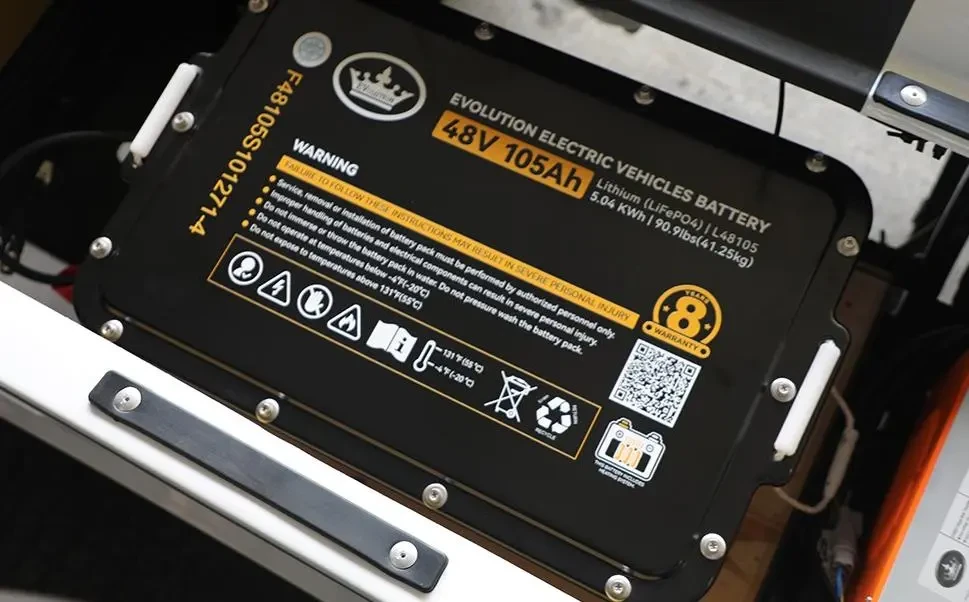
105Ah LiFePO4 — suited to standard passenger carts, resort shuttles and light utility duty with moderate daily mileage. See the 105Ah lithium battery specification.
160Ah LiFePO4 — for high-mileage routes, multi-shift operations, utility vehicles carrying load, and hilly terrain. See the 160Ah lithium battery specification.
Both are supported by the same BMS platform and are serviceable through the dealer network. Browse the full lithium battery range, or see how the packs are integrated across the golf cart range.
Frequently asked questions
Can I replace lead-acid with lithium in an existing cart?
Yes, in most cases, provided the vehicle's controller and charger are compatible with the lithium pack's voltage profile. The charger almost always needs to change. A drop-in replacement done without checking charger compatibility is the most common cause of premature lithium failure.
Is lithium safe in hot climates?
LiFePO4 is the most thermally stable of the common lithium chemistries and performs well in high ambient temperatures. Specify a pack with active BMS temperature monitoring, and avoid charging immediately after heavy use in extreme heat.
How long does a lithium golf cart battery actually last?
Typically 8–10 years in daily fleet service, or 3,000–5,000 charge cycles, whichever comes first. Calendar ageing also applies, so a lightly used pack may still need replacing after a decade.
Does lithium increase the resale value of the cart?
Yes. A used cart with a healthy lithium pack and documented cycle history commands a materially higher resale price than the same cart on aged lead-acid.
Choose the Right Battery With HDK
Tell us your route length, daily mileage, gradient and shift pattern, and our engineering team will size the pack correctly — no overselling, no undersizing. Request a battery specification and quote →